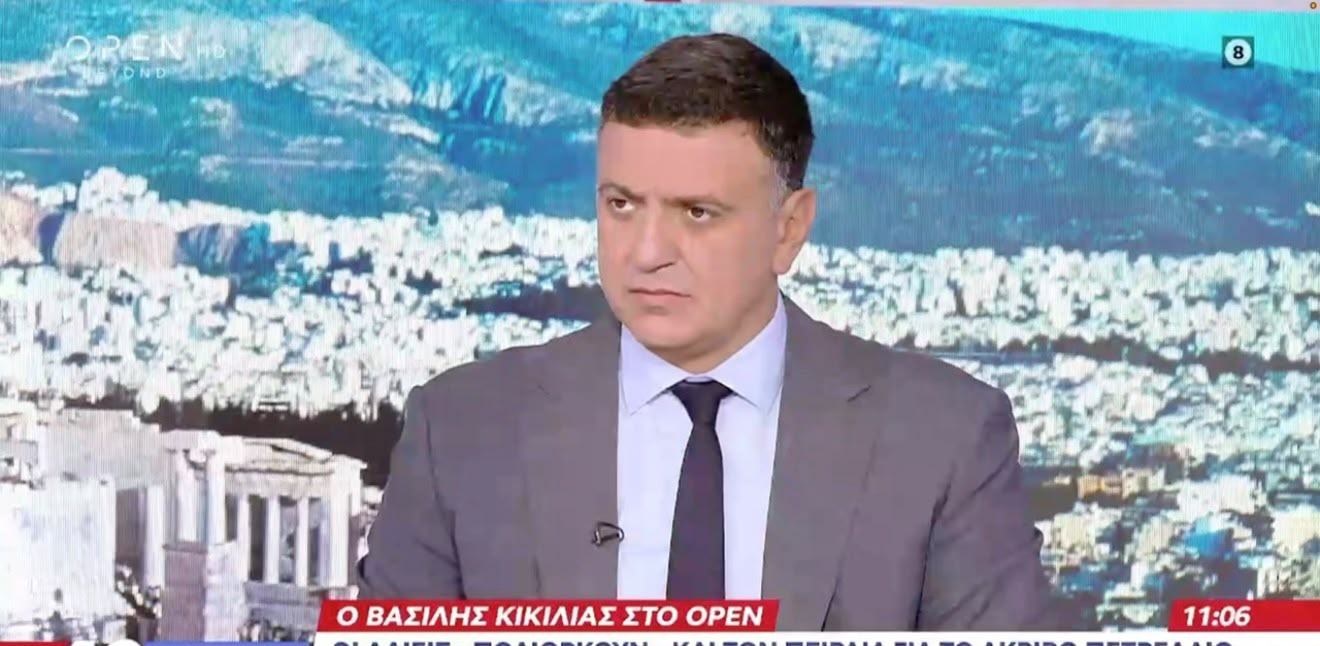
V. Kikilias: “The government’s job is to support people through difficult times”
Minister of Maritime Affairs and Insular Policy Vassilis Kikilias discussed protests by commercial fishers, the European Union’s stance on the need to support citizens and businesses, government policy to ease the pressure of rising prices on society, and the protection of maritime borders in an interview with journalists Nikos Stravelakis and Katerina Papakostopoulou on OPEN television.
On the protests by commercial fishers and the difficulties facing the sector as a result of the sharp rise in fuel costs, Mr Kikilias said: “Fishers, as you can understand, are under strain because of the increase in marine fuel costs. We are in the midst of war, an energy crisis and inflation, and there is no sign of these pressures easing, at least on the evidence so far. We support them in every way we can. However, this issue does not fall within my remit: it is the responsibility of the Ministry of Rural Development, and Deputy Minister Mr Kavvathas, together with Mr Schinas, is already negotiating with them. Alongside the Ministry of Finance, which also has responsibility, they are trying to find a solution to the financial side of the issue.”
He added: “These people have their concerns, as does every sector. And we are here to support and help them. That is the job of a government with a social and patriotic commitment. That is why, on my instructions, the Secretary General of the Aegean and Insular Policy, Fotis Mangos, and the First Deputy Commandant of the Hellenic Coast Guard, Vice Admiral HCG Mr Kiamos, met with them and received their memorandum. We will forward it to the Ministry of Rural Development, the Ministry of Finance and, of course, the government.”
The Minister stressed that the government had stood by citizens through every successive crisis in recent years, while also taking care to maintain fiscal stability: “Throughout all these cycles of crisis, from 2019 to today, I have never seen the Greek government fail to help and support people. On the contrary, in every crisis, from the pandemic until now, we acted swiftly and provided support as far as we could. Because, clearly, we do not want to return to those bleak years in fiscal terms, blow everything apart and leave the country to pay the price. We are trying to help every social group and every professional group.”
Responding to fishers’ complaints about the presence of Turkish fishing vessels in the Aegean and the Hellenic Coast Guard’s response, Mr Kikilias said: “The Coast Guard’s military leadership and all our Coast Guard personnel protect Greek and European maritime borders. Whenever there is a violation or unlawful activity, they intervene to ensure that those acting unlawfully leave. All these incidents are reported to the Ministry of Foreign Affairs. I have personally made representations to the Commissioner responsible, our Cypriot colleague handling fisheries in the European Union. In every case, our Coast Guard personnel do their job with selflessness, patriotism and a sense of duty. But let me be clear: always within their remit and the rules of engagement. Because I am certain that none of us — neither our fishers, nor our island residents, nor we ourselves — would want inadvertently to trigger an incident that anyone could exploit as a provocation.”
Mr Kikilias also discussed the overall work of the Hellenic Coast Guard, saying: “The men and women of the Hellenic Coast Guard guard our maritime borders day and night. Whatever happens — drug trafficking, refugee and migration issues, search and rescue, and so on — they are there. Because, under the laws of the sea, when someone is in danger and in need, the Coast Guard of course rushes to help and carries out its humanitarian duty too. We should honour this work by our Coast Guard personnel in a spirit of patriotism, and under no circumstances should we diminish it.”
On Prime Minister Kyriakos Mitsotakis’s letter to European Commission President Ursula von der Leyen requesting greater fiscal flexibility to support citizens and businesses facing the impact of the energy crisis, Mr Kikilias described this stance as essential. He cited coastal ferry services as a clear example, stressing that this was not simply a matter of supporting a business sector, but an issue of social cohesion, island connectivity and protecting tourism and the country’s economy as a whole.
He also criticised Europe’s leadership for its slow response to major crises, noting that European decisions were often taken only after societies had already paid a heavy price. “It is right to press for this, and we are ready, because ferry services, too, need support and assistance,” he said, recalling that €60 million had already been allocated to support the sector, an intervention that had helped keep ferry ticket prices in check.
He added that Greece must continue to press its case within the European framework and persuade its partners, the European Commission and Europe’s leadership of the need to adapt policies to today’s conditions. He stressed that the goal must be convergence and a stronger European Union, at a time when Europe was losing competitiveness against the United States and China.
In this context, he also referred to the strategic importance of Greek shipping for Europe, describing it as one of Europe’s strongest assets for trade and the economy. “It is a continuous negotiation,” he said, adding that sending a letter was only part of the effort and stressing that “we are ready to do what is needed to protect our fellow citizens”.
Turning to the political debate over benefits and support for social and professional groups, the Minister said: “There are politicians doing the rounds of the television channels. I see the opposition engaging in a free-for-all of handout promises right now. It is the same reckless promising that devastated Greeks years ago, cut their wages and pensions and led them to ruin. Anyone who is a patriot must distinguish between what we need to provide to everyone to support society and professional groups, and what led to disaster and passed on to our children and future generations a debt that, at one point, was insurmountable.”
In closing, Mr Kikilias referred to the government’s main priorities and the outlook for the future: “Our government has shown that we are here, standing by people through difficult times. We must acknowledge our mistakes, our shortcomings and the problems that have arisen during these years in government, and offer a vision and hope for the future. That means better-paid jobs, hope for the next generation, internal security, external security and support for the economy on realistic terms. And we leave no one behind.”
Διαβάστε το Δελτίο Τύπου στα Ελληνικά
Σχετικές εικόνες